Sunday, May 07, 2006

Plane tickets aren't cheap


We love you.

Thursday, May 04, 2006

Hot Weather... and getting hotter

The past week has been absolutely beautiful here weatherwise! Everyday, it has been sunny and between 20 and 25 degrees celcius, so nice. I'm not used to such an early spring, but it's quite nice. The trees are now in full bloom, the world is green again (well, if you're looking away from the asphalt and apartment buildings). We got to Korea at the end of August and it was extremely hot, about 38 degrees on most days. But I have since been told that June and July are actually the hottest months here, so I shudder to think what the temperatures will be. Coming in at the end of August we also skipped the rainy season. So, we are in for a treat there in the coming months.. starting half way through June I think. It rains really hard almost every day. Right now though, I am enjoying the warm weather and the sunshine.

Already however, I have had to restrict my running to after the sun goes down. The afternoons are too hot to run in. Although it is only about 23 degrees, the humidity is usually between 85 and 100 percent so the weather webpage informs us. So, I don't run in the heat. It is still quite warm in the evenings. I now run only 3-4 days a week, usually every second day. I don't know what I'll do for exercise when the rainy season starts, it will be very windy as well as very rainy, probably almost impossible to run in. Maybe I'll have to join the gym again, or maybe just the swimming pool. Who knows?

Although we are both well adjusted to life here and it doesn't bother us as much as it used to, we are both looking forward to getting home in a little less than four months. We have started counting down the days.... only 112 more to go! (112 days makes it seem so much longer than 4 months). It will be so good to see everyone again and to finally see my three new nephews who aren't so new anymore, but they're new to me, so I can't wait to see them! Sometimes we talk about when we will go home.. how excited we'll be to be teaching our last class, getting on the plane, arriving in Toronto, knowing that we are only a two hour flight away from home and then landing at the Halifax airport... we will both be very excited. Now we are starting the four month task of shopping for souveniers, something we haven't done any of yet... we must be the worst tourists ever... although I guess we're not really tourists since we've been living here for the whole year.

Tomorrow we have the day off... long weekend yay!!! May 5th is Children's Day in Korea, and it is a holiday. This year Buddah's birthday also lands on May 5th, denying us the regular two holidays in May in Korea... they're combined into one this year. The week surrounding Buddah's birthday is an interesting time around here. People buy lantrens from the monks and they are all hung in the streets, each lantren you buy is supposed to bring more blessings on to your family and loved ones. It sounds like an elaborate scheme to get money if you ask me. But it does make for colourful streets. I haven't taken any pictures of the lantren lined streets yet, I'll have to do that and post them. There are also many traditional ceremonies, parades and so on.

Well, I'd better sign off for now... this is getting way to long for anyone to bother reading.

Deborah

Monday, May 01, 2006

okay.....

This is just a funny story we thought we'd share...
Last night, or early this morning, I awoke to the feeling of the quilt being flapped up and down somewhat violently on my head. I asked Scott "Scott, what on earth are you doing?" he replied, half awake at this point... "trying to keep you warm". I thought to myself.. yeah sure, okay..., then I asked "are you dreaming?" and he said "yes". Really bewildered as to what he could possibly be dreaming about that would make him flap the blankets up and down, I asked "about what", and he said "you wrote a square on the board and I have to erase it". I just said "oh, okay" and went back to sleep. But we both laughed a lot about it at breakfast that morning.. Scott only slightly remembered it. It was quite funny, I still don't see how flapping the quilt would erase the white board in his dream, but dreams are funny things.
So, remember to ask questions if someone is doing something really strange in their sleep, because depending on how coherent they are, you could get some pretty humorous answers.

Sunday, April 30, 2006

Music Online

Don't worry, I'm not here to sell Sufjan Stevens albums. I'm here to sell myself. That's right! We have a music page, and we'll probably never post on it, except for this one song fragment. Anyway, the link is on the sidebar.

I made this song with my roomate's guitar and Audacity, an open-source program for recording music.

Thursday, April 27, 2006

Christian Women, Confucian Women

Korea is historically confucian. That means that men are considered important than women. In fact, I've heard that until fairly recently, abortions of females was pretty common. Also, older parents in Korea take much more care over their sons' lives than they do over their daughters'. Korean society is changing now, and so is the treatment of women.

However, the older, Confucian, society was partly right. Women were in charge of the house and the children, as they are in Christian societies. Husbands were the heads of their wives, as they are in Christian societies. (Actually, as they are in every marriage whether they recognize it or not). Their error was in not honouring the women. Because the women were under authority, they thought of them as less important. But Christians can't think that way. Authority is not the same as superiority. We see this in the nature of the triune God. As the husband is the head of the woman, so the Father is the head of Christ (1 Cor. 11:3). However, Christ is equal with God (Phi 2:6,7), and husbands are wives are equal. Husbands are to love their wives (Eph 5:25), making them beautiful (v. 27) and loving them as they love themselves (vv. 28,29). Also, Christian husbands ought to praise their wives (Pro. 31:28). Proverbs says that she'll be praised in public places (v. 31).

This means we should never say things like, "Men make the money and women spend it." Men who says things like this should have to walk down a row of elders that each has a paddle. In public people should only hear us praise our wives. Of course, it should never descend into boasting or competition.

The nature of God is our picture for all types of authority, including civil and ecclesiastical authorities.

Sunday, April 23, 2006

The Box Office Ballot Box

Here's an argument why you should go to the movies on May 19th. Unless you don't go to the movies on principle. Then don't bother.

Tuesday, April 18, 2006

Here's how some of us see it

A family sits down and eats a wonderful meal, so filling and satisfying that after it they feel like they'll never need to eat again.  It has plates and plates of savoury meats; baskets full of steaming breads and rolls; creamy potatoes with plenty of butter; and juice and then dessert.
 
After they finish eating, they all go into the living room and gather around the bare coffee table.  Then they stir themselves up to a fearful solemnity and proceed to pretend that at this table they are partaking of the most wonderful foods.

Saturday, April 15, 2006

Springtime and Easter


Springtime in Seoul looks a lot better than the other seasons. The trees are lined with cherry trees that are now in blossom. The blossoms blow in the wind and look like snow... it's quite beautiful. Also there are many magnolia trees, if you are like me and had never seen a magnolia tree, they are very beautiful. They look like a tree covered in water lilies.

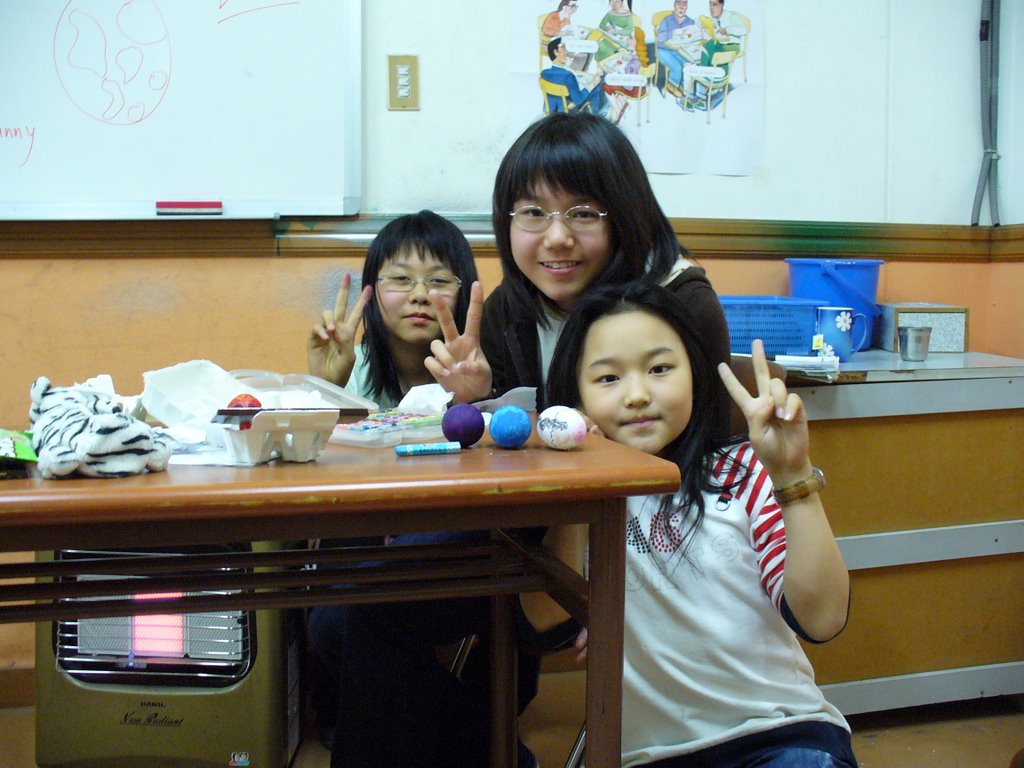
Tomorrow is Easter and we will miss our families. We will be spending most of the day at the church participating in the various Easter programs. I was actually able to share a bit about Easter and the reason we celebrate it with the kids in one of my classes, three girls. They of course don't celebrate Easter, because they don't have the holiday here, but they were very interested in our traditions. On Friday night I didn't do the textbook, instead I gave the girls a printout about the history of Easter and we read it together. I was able to share about Jesus' death and ressurrection and explain it to them. Then we talked about other traditions like chocolate, easter eggs and the easter bunny. Then I gave them each some chocolate and brought eggs for them to paint. They had never painted eggs before so it was quite fun. We had to use boiled ones because I didn't have time to blow them out before class... Eugene broke hers and ate it.

If you are interested in any of these things, check out the new pictures of springtime in GwangMyeong and Painting easter eggs with my class.

Thursday, April 13, 2006

Some light reading

After the last few of Scott's posts, I thought anyone reading might like some light reading to balance out the heavy topics previously discussed. And so, I bring you some of the lighter stories of my week.

It's so funny that with the language barrier in the classroom, you have to be really clear in your meanings. During one of my 8pm classes, they were learning the names of food ingredients and reading menus at restaurants. The book suggested that they all make pizzas using art supplies. Since I did not have the supplies suggested, I decided that we would all make a pizza together on the white board. I then told the class: "Okay, now we're going to make a pizza together..." I then proceeded to walk to the board. One of the children... Andrew...said "but teacher, we don't have any sauce, no toppings... no cheese!" He was so serious and said the last part so emphatically... it was so funny, I wanted to laugh so hard, but I was afraid that he would be upset thinking that I was laughing at him... so I simply explained that we would be drawing it on the board.

The next story has nothing to do with the children... only my own stupidity.. and that is the best kind of story. Two evenings ago, I was walking home from the school and absent mindedly walked into the wrong apartment building. Since all of the buildings look exactly the same on the inside and out, I didn't notice; just made my way up in the elevator to the thirteenth floor, walked to apt. 1307 and put in my key. At first, my key wouldn't fit the lock and so I joggled it a bit until it fit and turned (the door must not have been locked properly). Opening the door I came face to face with a Korean woman wearing an apron, who looked at me strangly and said in a questioning voice "Yobosayo" (or Hello?). I was equally as confused, not cluing in that I was in the wrong building, so I took a peek inside then quietly said "I'm sorry" and walked away. She closed the door but I just stood there, I was still really confused, I checked the apartment number and then the floor I was on... both right. I thought that I must be dreaming some strange dream. It wasn't until I was on my way down in the elevator that I finally clued in that I was in the wrong building.

Anyway, that was my week

Tuesday, April 11, 2006

The Myth of Religious Neutrality

Some beliefs are obviously not religious, such as my belief that I'm going to have noodles for lunch. That's not religious, even though it elicits thanksgiving. I think it's true, however, that everyone has some sort of religious belief. As Chesterton, like always, once said, if man refuses to worship God, the result is not that he will worship nothing, but that he'll worship anything. But even when it doesn't result in worship, I think everyone has religious beliefs. What makes a belief religious? This is the question Roy Clouser asks in the first chapter of his book The Myth of Religious Neutrality.

To answer this question, we need to determine what all religious beliefs, and no other beliefs, share. Usually, people tie in religious beliefs with worship. However, in some religious traditions, worship is non-existent, for example, in some forms of Buddhism and Hinduism. Others think that religious beliefs serve the purpose of giving a group an ethic. Again, though, many groups which aren't religious have ethics. From what I understand, Confucianism is only a code of ethics for a well ordered society.

These obvious definitions fail us. Continuing on, then, one might define religious belief as belief in God or in gods. Once more, though, we are foiled by counter-examples. Pythagoreans did not believe in God or in gods. They believed that numbers were the primary things in the universe, the stuff of which everything else was made. They held, as a religious belief, that 1+1 = 2.

Roy Clouser proposes another definition of religious belief, one which I think covers the basics. He calls it primary religious belief. It covers the whole spectrum of religions, and only religions. It is this:

A religious belief is belief in something as diving per se no matter how that is further described, where “divine per se” means having unconditionally non-dependent reality.

This definition does not assimilate the different ideas of what is divine. It says that every religious belief is about what is divine per se, but allows that different religions believe different things are divine per se. Pantheists believe one thing, Christians believe another, and atheists believe yet another. This definition, as the last sentence revealed, includes even the supposedly non-religious. Some people don't like to include atheism as a religion, but we should. Atheism and theism are enemies, after all, in a way that theism and, say, the PTA are not, or that Atheism and the Engineering society are not.

This is only the first chapter of this book, but I'm really excited about it. Clouser promises to prove that all theories necessarily depend on one religious belief or another. Such an argument would disarm opponents who try to devalue Christian arguments because they are religious. We can rejoice, as we always should have, that our arguments are religious. They are inevitably so.

Saturday, April 08, 2006

The Emasculated Church

Church hopping is like bar hopping, although it takes more than a night to make the rounds. The church, so it seems, is a place where people that think along the same lines join together to hang out, and if you begin to differ somewhat in ideas you can go somewhere else. Others, however, think that the church is more like a family, where people with differences are bound together. Sometimes the family squabbles, but it's family and, except under certain extreme cases, it has to stay together. In the same vein, the church is like a city or civilization. Here's a little story from Mark Horne to illustrate:

An American drives into Canada and eats at a diner. His waiter asks him where he's from. “Oh, from America! I'm actually an American, too.” “Really? You were born there?” “No.” “Are your parents American?” “No, sadly they were Canadians their whole lives, but I've been reading this tract about American ideas and I'm fascinated by them. Now I've memorized the Declaration of Independence and I'm firmly committed to Americanism.”

This is odd because one doesn't become an American by holding certain ideas. America is an institution and not primarily a belief system, and one must enter it by a certain way. Similarly, one sometimes hears that Christianity is not an -ism. Peter Leithart, in his book Against Christianity, writes: “The Church is not a people united together by common ideas, ideas which collectively go under the name 'Christianity' ” (Canon Press, Moscow, ID. p.14). Rather, we are united in one faith, which is an entire way of “leaning into life.” We are a new culture, a new people, like the old people of God. We are united by our ritual of baptism (Eph. 5.4-6). We are united because we eat the same bread (1 Cor 10.17). We are new culture, a new people, like the former people of God, and we are united by our rituals.

We are a kingdom like other kingdoms, except we are the kindgom of God. We cannot divide between the religious and the secular, religion and politics:

In the New Testament, we do not find an essentially private gospel being applied to the public sphere, as if the public implications of the gospel were a second story built on the private ground floor. The gospel is the announcement of the Father's formation, through His Son and the Spirit, of a new city -- the city of God (16).

When one understands the church not as the city of God but as a social group like the ymca or a literature society, then it loses one's devotion, and “real life” takes place outside of the church; taking part in the church is an extra thing added on to life, which one can choose to belong to or not. In Psalm 2, however, we get a different picture:

I will tell of the decree of the Lord: He said to me, “You are my son, today I have begotten you. Ask of me, and I will make the nations your heritage, and the ends of the earth your possession. You shall break them with a rod of iron, and dash them in pieces like a potter's vessel (vv. 7-9).

Jesus will destroy the other nations, not by force but by the transforming power of the Spirit. They will be assimilated.

The book of Daniel makes similar points. In chapter 2, Nebuchadnezzar has a dream about a large statue with a head of gold, breasts and arms of silver, a belly and thighs of bronze, legs of iron, and feet of iron and clay (vv. 32,33). Then “a stone was cut out by no human hand” and it smashed all the statue to bits, which the wind carried away so that no trace of them could be found; but the stone that smashed them “became a great mountain and filled the whole earth” (vv. 34,35). The different parts of the statue, according to Daniel, and of course he's right, were different kingdoms. The stone that smashed these kingdoms and was established forever was the kingdom of God. The kingdom of God is not friendly with other kingdoms. It destroys them, smashes them to bits.

Perhaps this is in the future, though. Perhaps the kingdom is not yet. In Jesus's ministry, however, he talked as though he were bringing in the kingdom. He talked as if the kingdom were there because he was there: “But if it is by the finger of God that I cast out demons, then the kingdom of God has come upon you” (Luke 11.20).

Some might say that the kingdom of God is not even on earth, but is another realm, because Jesus said that his kindgom is not of this world. We can understand this in another way, however, and in a way that is consistent with scriptural language. When something is not of the world, it doesn't use worldly methods, and we have our own methods: “For though we live in the world we are not ccarrying on a worldly war, for the weapons of our warfare are not worldly but have divine power to destroy strongholds” (2 Cor 10.3,4).

Back to Leithart for the conclusion. He thinks that the way we view the church nowadays (which I haven't well defined, by the bye) is a great heresy. He calls this heresy Christianity, by which he means treating scripture like a system of ideas to which we give our assent and then there's an end of it (14-15). He says: “Christianity is the heresy of heresies, the underlying cause of the weakness, lethargy, sickness and failure of the modern church” (13).

Like, you know, whatever.

Works Cited (In preparation for returning to school)
Leithart, Peter. Against Christianity. Moscow, ID: Canon, 2003.

Wednesday, April 05, 2006

Busheeshee

Hello again everyone... I thought I'd write on the blog because I have nothing better to do at the moment, so you all will suffer the reading of a boring blog about pretty much nothing.
Hmmm.... well, on Saturday night Scott took me on a date to the Seoul Arts Centre to see a performance by the Korea Symphony Orchestra. They did two symphonies and a movement of a third. The one movement was by a Korean composer. It was very strange.. I didn't like it as much as the German or Russian symphonies they played. The Korean music used traditional instruments in the orchestra (traditional drums and a gong). Anyway, it was a good night, the music was beautiful and the building was beautiful. Next to the arts centre is the opera house. We did not go inside, but the outside of the building is big and round and looks kind of like a Greek coliseum. It also had big fountains in front and the water movements went along with the music that was playing... it was kind of cool.
The weather has been quite nice here, spring has come. Today it was 18 degrees and very sunny. I have ended my gym membership now and have been running outdoors along the river that is close by our apartment. I usually run about 7.5 km 3-4 times a week, so I guess I'm not as consistant as when I was going to the gym, but on days when I don't run I usually walk a lot, so I'm keeping pretty fit.
Today was the first time that I have been told that my hair was 'busheeshee' (not the correct spelling... but that is the phonics of it). After washing my hair this morning I put it in braids, then before my evening classes, I had taken them out. Two of my middle school girls told me that my hair was 'busheeshee'... it means fuzzy .. I guess. I think 'busheeshee' sounds better, I'm going to start using it when referring to someone's puffy hair.
Anyway, that's all for now

ta ta

Monday, April 03, 2006

WCF and LBC, chapter II

The second chapters of the Westminster Confession and the London Baptist Confession discuss "God and the Holy Trinity" (LBC 2). Both begin by saying that "there is but one only, living, and true God" (WCF II.I). This God works all things according to His will and for His own glory. He is
most loving, gracious, merciful, long- suffering, abundant in goodness and truth, forgiving iniquity, transgression, and sin; the rewarder of them that diligently seek Him; and withal, most just, and terrible in His judgments, hating all sin, and who will by no means clear the guilty (WCF).
The only difference is that the LBC replaces "and withal" with "And Who, at the same time."

God's glory and goodness all come from Himself, and he has no need of any of the creatures which he has made (WCF II.II and LBC 2.2). All things were created by Him and for Him. He has "sovereign dominion" over all His creatures, and He can do with them whatever He pleases. All of His actions and commands, however, are perfectly holy. Humans and angels must give Him whatever worship and obedience He asks of them, and the LBC adds whatever worship and service they owe Him as his creatures.

Chapter III, section III gives the doctrine of the Trinity. The LBC begins: "In this divine and infinite Being there are three subsistences" (2.3). The word "Being" emphasizes that God is one being. The WCF begins: "In the unity of the Godhead there be three persons" (II.III). This also emphasizes that God is one being. Both confessions state that these three persons are "one in substance, power and eternity (LBC). Being one in eternity means neither existed before the other. The LBC adds another clause to make this specific; the WCF doesn't. Finally, both state that the Father proceeds from no one, the "Son is eternally begotten of the Father" (WCF and LBC) and the "Holy Spirit proceeds from the Father and the Son" (LBC). Actually, the WCF says "Holy Ghost," which leads me to believe that its writer's might have been necromancers. If so, we can expect the two confessions to diverge later on.

One more thing (sorry for the above "finally"). The LBC concludes this chapter thusly: "This doctrine of the Trinity is the foundation of all our communion with God, and our comfortable dependence on Him." The WCF has no corresponding clause, but nevertheless the trinity is a central concern in reformed theology.

Tuesday, March 28, 2006

If you have the time

Here's a short article about how a church liturgy is defiant of the world. It's the second article on this page, so if you're interested, scroll down until you see "Liturgy and the Counter-Cultural Church" by Peter J. Leithart.

Monday, March 27, 2006

A Comparison of...

There is a confession of faith that most reformed churches suscribe to, namely the Westminster Confession of Faith, 1646 (WCF)and there is a confession of faith which many Baptists, including Spurgeon, suscribed to, namely the London Baptist Confession, 1689 (LBC). I have decided to compare these two confessions of faith to see what are the main differences between old Reformers and old Baptists. There will be be no argument here, only a cursory comparison.

Both confessions begin with the Holy Scriptures, and both further divide this section into ten subsections.

In the first section, both agree almost to the point of using the exact sentences. For example, the WCF states that
Although the light of nature, and the works of creation and providence do so far manifest the goodness, wisdom, and power of God, as to leave men unexcusable; yet are they not sufficient to give that knowledge of God, and of His will, which is necessary unto salvation.
and the LBC states that
Although the light of nature and the works of creation and providence manifest the goodness, wisdom, and power of God so much that man is left without any excuse, they are not sufficient to provide that knowledge of God and His will which is necessary for salvation.
Both state that God wrote down his word so that neither man nor Satan could tamper with it, and because He has ceased revealing his will in the way he used to.

In the second section, they give the same list of inspired books, which are to be "the rule of faith and life" (WCF; LBC), and both confessions devote section three to denying the Apocrypha a place in the canon.

In fact, they say nothing different, and agree that: the Holy Spirit assures us that the scriptures are from God and therefore authoritative (section V); scripture contains, explicitly or by necessary deduction, all things necessary for God's glory and for our faith and life (section VI); not all things are equally plain, but what one must know for salvation is plain for anyone who will take the time to read it (section VII); God has preserved the scriptures through the ages, and the scriptures, though the original languages have the final authority in controversies, should be translated into all languages for people to read(section VIII); if one passage of scripture is difficult, then we should understand it in the light of another, more clear, passage (section IX); and that all controversies of religion are to be solved by reading scripture and being taught through scripture by the Holy Spirit (section X).

Finally, these confessions state that all decrees of councils (that includes these confessions) must be judged by the scriptures (section 10).

Note:

The version of the LBC that I used was edited by Spurgeon. This version, as well as the original and the WCF, can be found at this site

Gwanaksan Mountain


On Saturday we went to Gwanaksan Mountain to go climbing and hiking. It was really fun and warm... really windy though and a very difficult hike. It took us six hours (we stopped for one hour in total for breaks such as lunch... so really five hours). The next day and still today... three days later, I am very sore. I didn't think I would be since I exercise regularly, but they must be different muscles that you use for climbing. Scott was very sore as well.

It was beautiful and very interesting. Scattered throughout the mountain were lookout spots (little hidden caves with windows) from one of the wars, I'm not sure which. We couldn't go into most of them because they were closed off with barbed wire, but some had open doorways so we explored a bit, it was cool.

My favourite quote from the trip is from a Korean man who was hiking behind me. I had just pulled myself up a rock face on a rope and he said "Very good... like Jane". Scott and I both thought that was pretty funny... If I'm Jane, he must be Tarzan.

Well anyway, it was a good time and the pictures are posted in our photo album if you want to see them.

Monday, March 20, 2006

Unity in Diversity, pt. 2

Sometimes we have to cut off our fellowship with a Christian. Sometimes it's over a doctrine, as when John the gospel writer left the bath house because some Gnostic was in there, and sometimes it's over behaviour (cf. 1 Cor 5.1-2). Other times, we don't have to cut off fellowship. If Joe is a vegan, so be it. Let him be a vegan. If Susie dyes her hair, great! I like it, Susie. I've already said that Paul says we can have unity when we have differences, as long as the differences are about things indifferent. Let's call these peripheral issues. When defining what are peripheral issues, we can get clarity by defining the center, and in the New Testament, we get a clear picture of what is central. What is central is that

Christ died for our sins in accordance with the scriptures, that he was buried, that he was raised on the third day in accordance with scriptures, and that he appeared to Cephas, then to the twelve. Then he appeared to more than five hundred brethren at one time, most of whom are still alive, though some have fallen asleep. Then he appeared to James, then to all the apostles. Last of all, as to one untimely born, he appeared also to me. For I am the least of the apostles,unfit to be called an apostle, because I persecuted the church of God. But by the grace of God I am what I am, and his grace toward me was not in vain. On the contrary, I worked harder than any of them, though it was not I, but the grace of God which is with me. Whether then it was I or they, so we preach and so you believed (1 Cor 15.3-11)

Now, Paul says that these things are of first importance: Christ died for our sins; rose from the dead; and revealed himself to many brethren. In fact, if he hasn't risen from the dead, then we are still in our sins and our faith is vain (vs. 17). Similarly, in the first chapter of Acts, Luke recounts the story of Jesus's death and resurrection, and how he revealed himself to his disciples. This paraphrase is reminiscent of how Old Testament writers paraphrase the essence of older Old Testament stories. Paul also said his task was to preach Christ crucified (1 Cor 1.17), and that through believing that Christ died for our sin's God makes Christ our wisdom, righteousness, sanctification and redemption (vs. 30). This is the central doctrine and story which we have to believe. Of course, in scripture, many things follow from this, and we will believe those things as well. But this story (that Christ died and rose from the dead and showed himself to his disciples) and the meaning of this story (that he died for our sins) is the source of our unity.

Sunday, March 19, 2006

Yeah Baby!

 
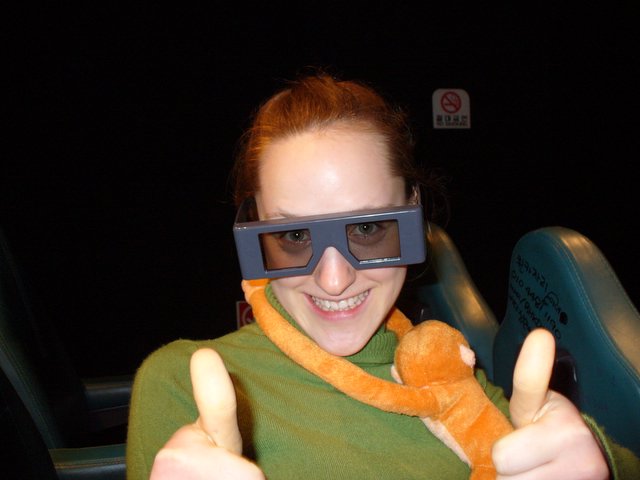
Well, this past Saturday Scott and I went to Lotte World... it's a large theme park in Jamsil. We had lots of fun and took lots of pictures, an example of which you can see here. This particular picture was taken just before we watched the 4D movie, in which we got sprayed with water, rumbled, eaten by sharks, attacked by rats etc.. it was weird, but fun. If you would like to see more of these fun filled pictures, just go into our photo album, they're there now.

The monkey around my neck I won by throwing balls and getting them into the targets behind a moving blocker... I won, I know... hard to believe, I was just doing it because I had never tried before, I didn't actually expect to win anything.

The rides were pretty fun, we were both exhausted from screaming by the end of the night though. One ride, "the Gyro", I don't know if I would ever do again... it takes you way, way, way, up in the air (rotating as it does this) and then suddenly drops.. you're in free fall, it was such a short time, but it felt like I would never reach the bottom, and if I did, I'd be squished into a pancake; but we both made it out alive.

The roller-coasters were also fun, we waited in line forever... almost forty minutes, but they were really fast and went upside-down and all around.. pretty scary but all around good fun.

There was a parade of over 100 performers later that night, they were mostly Russians, we took a couple of silent videos with our webcam, I'm trying to figure out how to get them online so everyone can see.

Well, anyhow,

enjoy the photos, we enjoyed our time. Posted by Picasa

Tuesday, March 07, 2006

Unity in Diversity

One of Paul's most liberating teachings is that we are to lay off and mind our own business. We are to accept weaker believers and not pester them with debates and unasked for advice.  Don't tell a parent, for example, how to cut the sugar out of her children's diets unless she has asked you how you did it. Another example: don't make comments to your friends about other girls' makeup, hoping that your comments will find some roundabout way of reaching their ears.

There is an example in the gospels about this. Jesus says that he came both eating and drinking and they called him a glutton and a winebibber, but John the baptist did neither and they said that he had a demon.  Jesus said nothing, however, against John; he didn't quote a passage from Paul and say, "You know, John, you're a weaker brother."  Likewise, Paul says to accept vegans as vegans. Don't try to convert them; lay off, he says.

Now, this applies only to secondary issues, to debatable things. On primary issues we are to be unbending. One should rebuke a believer that says his conscience forbids him to obey the first commandment. But what are the primary issues? The ten commandments should be taken as starters. They are laws which do not pass away, which must always be obeyed.  I'm sure there's more to say, but I can build on this foundation.

Imagine that a father, who is a faithful Christian, decides to have his infants baptized and to teach them that their baptism is legitimate, and next that when the infants grow up, a well-meaning but misguided brother-in-the-faith tries to teach the children that their father is wrong and is in fact disobeying God.  If he succeeds in teaching them this, what will he accomplish? Not the edification of the children, as he hopes.  Most likely, he will teach them one thing: to break the fourth commandment; to dishonour their father.  In this case it might be difficult, but the father, because he has been forgiven, must also forgive this brother, who caused his children to stumble. So, the father should promptly get his hands on a millstone, search out the deepest waters, and he and the brother should go out on a boat to perform the act of mercy.